



Organisation
Taro Agric Farm (TAF)
Sector
Agriculture & Food
Health & Life Sciences (Healthy Living)
Knowledge base
University of the West of England, Bristol
Share this article


Challenge
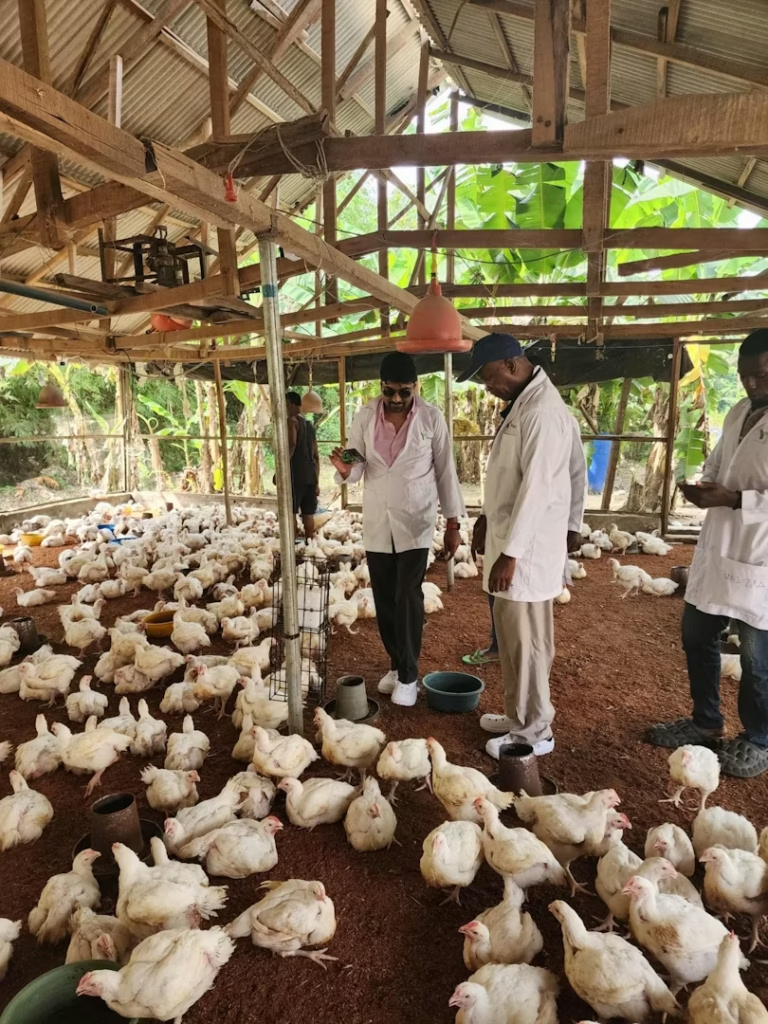
Taro Agric Farm (TAF) is a commercial broiler chicken production company based in Southwest Nigeria. Its operations span multiple centres, including the main site in Ile-Ife (Osun State) and out-grower units in Ilesa and Ibadan. The business produces around 4,000 birds per cycle, running 6 to 7 cycles annually, supplying wholesalers, retailers, hotels, restaurants, and a fast-growing network of smallholder farmers. Alongside production, TAF provides consulting, capacity building, and training across the broiler chicken value chain. Its workforce includes a core team of 12 and more than 30 contract staff during peak periods. With the adoption of digital innovations, the company has seen steady growth in turnover and profitability.
The poultry industry in Nigeria faces longstanding challenges, including high mortality rates, poor environmental management, limited real-time monitoring, and a lack of data-driven decision-making. Like many farms operating with traditional methods, TAF relied on manual data collection and experience-based intuition. This made it difficult to detect early signs of health risks or performance inefficiencies, particularly in areas such as ammonia exposure, temperature fluctuations, and other environmental factors that directly affect bird welfare and productivity.
To address these issues, a Knowledge Transfer Partnership was established between TAF, Obafemi Awolowo University (OAU), and the University of the West of England (UWE). The aim was to embed data-enabled innovations in broiler chicken production and establish a smart farming model capable of delivering long-term operational, economic, and welfare improvements. The project focused on introducing IoT technologies, predictive analytics, and real-time monitoring systems to improve flock health, survival rates, productivity, and overall farm sustainability.
The key objectives were to:
• develop and deploy IoT-based smart farming solutions for real-time monitoring of chicken health and environmental conditions
• enhance data-driven decision-making using a database and analytics tools to track farm activities and predict performance trends
• improve survival rates and productivity through early detection of risks using predictive analytics
Creating a Meaningful Evaluation Framework
The partnership introduced a structured approach to integrating digital technologies into poultry production. This included the deployment of IoT sensor nodes, the development of a farm database, and a Decision Support System (DSS) to support evidence-based management. Predictive analytics were embedded to identify environmental risks such as ammonia spikes, enabling timely interventions. Training, knowledge exchange, and stakeholder engagement ensured that staff and farmers could adopt and apply these innovations effectively.
The collaboration strengthened ties between OAU and UWE, facilitated exchange visits, led to joint research activities, and supported teaching and curriculum development linked to smart farming.
Outcome
The project delivered significant and wide-ranging improvements for TAF:
Operational efficiency and digital transformation
TAF shifted from traditional production practices to a technology-enabled, analytics-driven model. Staff gained the capability to deploy and interpret IoT systems, monitor welfare indicators, and manage digital data assets. Real-time monitoring reduced mortality by 22%, improved flock performance, and enhanced productivity.
Commercial impact
Sales turnover is expected to rise by 30%–40% within three years, with a projected 20% increase in profit before tax. Improved consistency and efficiency have enabled expansion into new markets, while demand for TAF’s consulting services has grown as other poultry farms seek similar digital solutions.
Environmental and societal benefits
Using solar-powered IoT systems reduced energy costs, while real-time detection of noxious gases supported better waste management. More than 100 farmers were trained in smart poultry practices, strengthening local agribusiness capacity.
Innovation and process development
The project delivered IoT-based monitoring, a decision support system, and integrated farm data analytics, establishing a model for precision poultry management in Nigeria.
These achievements led to Taro Agric Farm being named the winner of the African Agriculture KTP Award at the 2025 KTP Awards, recognising the project’s pioneering role in advancing smart poultry farming across Africa.
Impact
The partnership has had a lasting influence on TAF and the wider agricultural ecosystem. It demonstrated how digital technologies can significantly improve animal welfare, productivity, and farm profitability in resource-constrained settings. The project has set a benchmark for sustainable poultry farming models in Nigeria and has inspired new agritech initiatives across the region.
For the universities, the work generated new research, expanded teaching materials, strengthened industry engagement, and created opportunities for students pursuing careers in agritech, data analytics, and smart farming. Joint publications and international conference presentations showcased the research impact globally. A new DEI Lab was established at OAU, embedding digital innovation further into academic and industry practice.

What they say
“This KTP was a game-changer for our business. Before the partnership, our farm operations relied on manual processes with limited access to real-time data. Through this project, we have embedded IoT-driven smart farming technologies that allow us to monitor our flock’s health, predict performance trends, and optimise efficiency in ways we never imagined possible.”
Share this article